

Purpose
This guide covers the recommended setup for teams moving from build to production on Affinda Extract - how to structure workspaces, manage model memory, and handle changes safely without disrupting live processing.These are recommendations, not hard requirements. Adapt the structure to fit your team size, governance model, and rollout cadence.
Recommended workspace structure
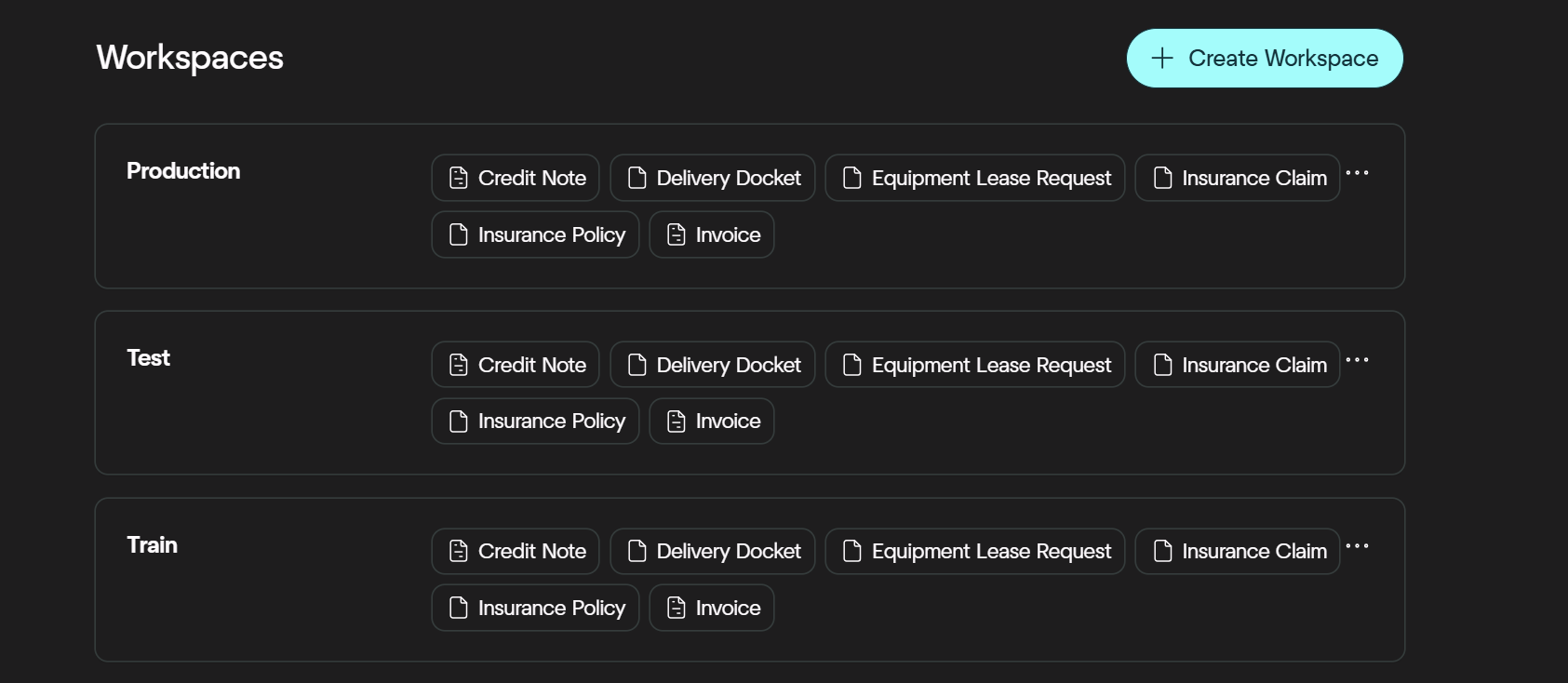
We recommend separating your organization into three workspaces, each with a clear purpose. Keeping them separate makes it easy to control access, isolate change, and keep production predictable.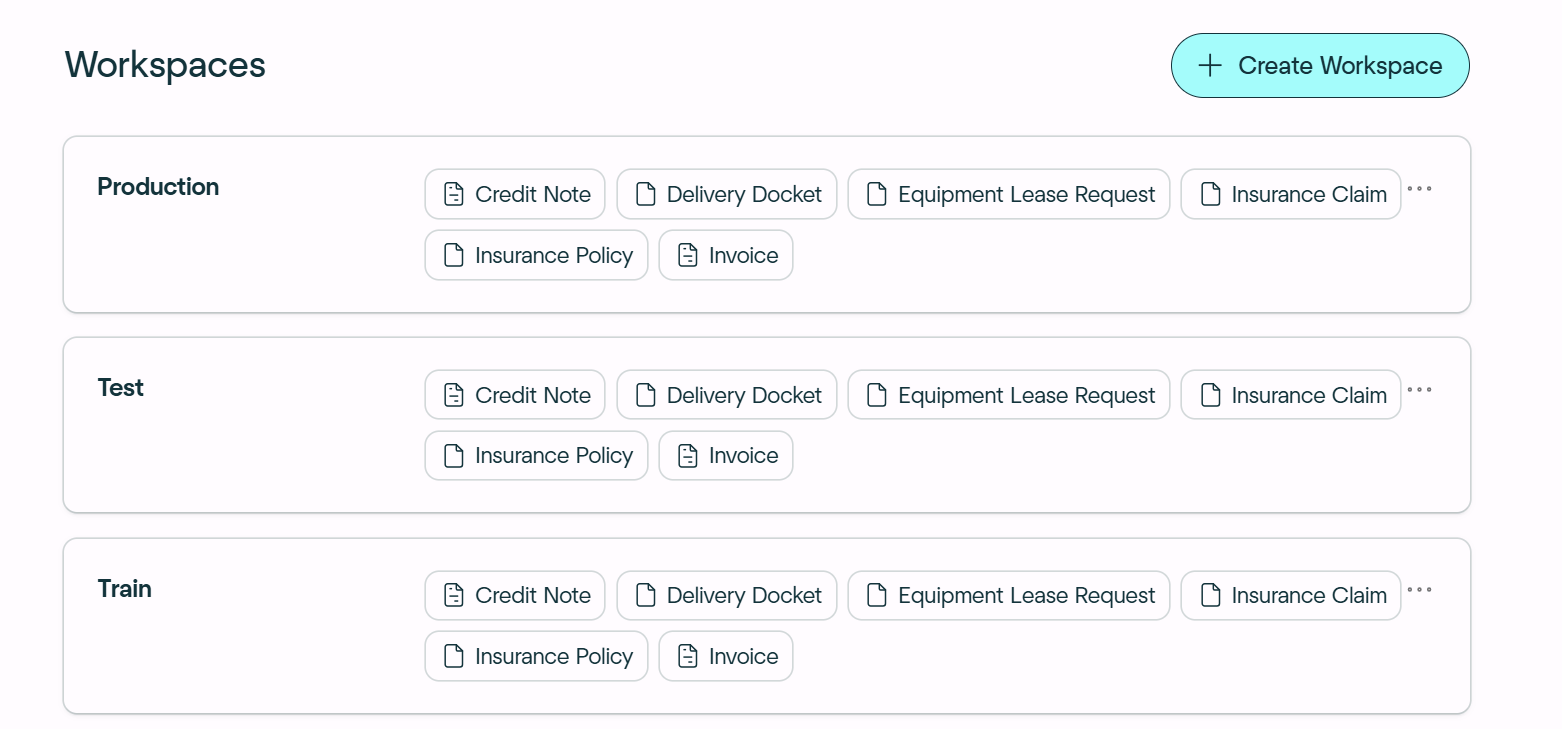
1
Training workspace
The source of truth for what the model has learned. All model memory documents live here.
- All confirmed model memory documents stored here
- Annotations updated here when fields or behavior change
- New document variations added here first
- Access restricted to configuration owners
2
Dev & Test workspace
A staging environment for validating changes before they reach production. Also used for UAT.
- Document types configured in Training are linked here
- Integration testing space
- No independent model memory; inherits the Model memory that lives in Train config
- Safe to experiment and break things here
3
Production workspace
Live document processing only. No training activity happens here.
- Model memory toggle turned off
- Document types promoted here only after testing
- All documents processed via API from here
- No direct schema edits — go through Training first
Making changes whilst in production
Once your workflow is live in production, you may still need to update your document types or workflow settings from time to time. Identify the type of change you want to make, then follow the recommended approach below.Scenario A — New document variation
The model is seeing a new version or variation of a document type already set up in the platform. It may not be performing well due to no closely matching example in the model’s model memory set. Approach: Add to model memory → Training workspace1
Upload to Training
Upload the new variation to the Training workspace.
2
Annotate and confirm
Annotate all fields correctly and confirm the document as model memory.
3
No deployment needed
Performance improves in production automatically — no deployment step required.
Scenario B — Small schema change
Adding or tweaking one or two simple fields. Approach: Edit in place → Training1
Edit the schema in Training
Edit the schema directly in the Training workspace.
2
Re-predict and reconfirm
Re-predict the new or changed field on the model memory document, then reconfirm it.
3
Takes effect immediately
Changes take effect in production straight away.
Scenario C — Significant schema change
Groups, nesting, structural changes, or anything that requires integration retesting. Approach: Duplicate → Dev/Test → Production1
Leave production untouched
Leave the existing production document type in place while you build the new version.
2
Duplicate in Training
Duplicate the document type in Training and make all changes on the new duplicate.
3
Rebuild model memory
Re-upload, re-annotate, and confirm all model memory documents on the new duplicate.
4
Test in Dev/Test
Link the duplicate to the Dev/Test workspace to test the integration flow and make adjustments.
5
Validate end-to-end
Validate the full API payload end-to-end against the new schema.
6
Promote to Production
Once sign-off is complete, unlink the old version from production and link the new one.